

Early in 2026, I was shocked to learn of the events surrounding support for Lucinda Ritchie (BBC, 2026), who lives in Sussex. It was upsetting to read her story. Lucinda had been in hospital, and the NHS had decided she would be placed in a nursing home an hour away from her family. This took place entirely against Lucinda’s wishes, as she had her own adapted home and, prior to her illness, her own trained care team who could meet her medical needs. Lucinda’s story emphasised for me the importance of planning for the future as an AAC user.
What made me take action?
Lucinda is someone I have met in passing, and in many ways, she is similar to me. She has studied at the postgraduate level, uses eye‑gaze to communicate, and has her own adapted home with 24/7 support. What Lucinda experienced on so many levels is wrong. From the press reports, it seems she was receiving legal advice and had people fighting her corner, but where were the supposed safeguards so people like us can be treated equally before the law, heard, listened to and understood? I could see that without access to AAC or essential communication support, it might be easy for a similar situation to happen to any AAC user.
Changes to the law
Further to this, there has been an immediate change to the law (June 2026) with a Supreme Court ruling (DHSC, 2026) around Deprivation of Liberty (DoL). The new judgment redefines DoL and from now on will rely on a multifactorial assessment; it is much more complex than before. Every decision must assess the individual’s specific situation and take into account the type, duration, effects, and manner of implementing restrictions on the person.
This appears good as it means the views of an AAC user must be taken into account in decision‑making, especially to ensure they are ‘content’ with their situation. Specifically, the ruling says that being compliant does not mean consent. An assessor must take into account whether the individual has difficulty expressing their wishes due to sedation, medication, fear of consequences, feeling pressured, or a belief that they do not want to be a burden on others. When assessing wishes and feelings, consideration should be given to what the person is communicating both verbally and through their actions and behaviour. For example:
- Do they appear happy or unhappy?
- Are they trying to leave, or are they distressed in any way?
- Are they able to express a view?
This is particularly concerning, there is a risk that a professional might mistake compliance with being content if they do not have experience of working with AAC users, or know the individual. We know how hard it can be to make yourself understood when you are ill or stressed, or denied access to your AAC resources, including a communication partner that knows you. Might you be pressed to make a decision without time to process the information, know all the alternatives, or have access to the vocabulary you need to express your views clearly. More importantly, if you rely on the ‘goodwill’ of a care team for your day‑to‑day support, there is always the potential risk of ‘complying’ to ensure you do not lose their support. It is sometimes easier to say yes when you want to say no out of fear of rejection.
Who does this apply to?
This new legislation applies to anyone over 18 in a hospital or care home, and to children and anyone over 18 living in the community where they have a Deputy authorised by the Court of Protection for Care. So, in other words, the worst-case scenario is that as an adult AAC user, you might go to the hospital, and your life might change.
The Supreme court judgement gave an example of when DoL would not apply. This states if a physically disabled person is unable to leave a setting independently due to illness, condition, or disability and cannot demonstrate a desire to leave, it will not be classed as deprivation of liberty.
What might this mean for AAC users?
When I combined these scenarios, I had some concerns about my future care and began to consider my own situation.
I know if I am in hospital, I cannot get out of a bed on my own or into my powerchair without assistance. I struggle to make myself understood without AAC and a trained communication partner who can read my body language, eye movements and facial expression. Even with AAC the staff are all so busy rushing around they often try to talk to whoever is with me rather than me.
To demonstrate intent, that I am not content, I need full access to all the resources I use every day — 1‑1 assistance, my charged powerchair and my charged AAC mounted in a way I can access it, a trained communication partner who knows me. Without these, then potentially I risk being unable to demonstrate a desire to leave or an assumption that I consent to an intervention.
Taking your own legal advice
Where did I start? I took some legal advice expressing my concerns, this took part even before the new DoL changes. It was suggested having a Lasting Power of Attorney (LPOA) for health and care was a good starting point.
Creating a Lasting Power of Attorney
As a family, we had completed Lasting Power of Attorney (LPOA) paperwork with my grandma a few years ago. It was done just in case it was needed as she aged. It turns out that now she has advanced dementia; this was a good call. I can see it has come in really useful for my mum, helping her coordinate her support and liaise with outside agencies. When the LPOA for health and care was suggested for me it was a tough call — but I realised in the future if, for some reason, my communication is compromised those supporting me would have clear guidance for what I wanted. It’s been quite a hard situation to recognise, even more so to think about.
LPOA needs to be verified by someone who is not an attorney (the attorney is a person you nominate in the LPOA and who acts in your interests if/when needed – see below). The verifier can be someone who has known you for at least two years, or someone with relevant professional skills, such as your GP, a healthcare professional, or a solicitor. The solicitor recommended that I take a Mental Capacity Assessment — not that anyone who knows me doubts my cognitive ability, but to ensure that if the LPOA is ever needed, there was evidence I was of sound mind, knew my own wishes, and was not influenced by anyone during the process of drawing up the documentation.
Appointing an attorney
An LPOA is completed at a time when the individual is capable of making decisions and is then held on file by the Office of the Public Guardian until it is activated by those people (attorneys) you have previously nominated to act for you. In my case, initially my parents, but I have already identified other attorneys for the future as I know they won’t be around forever. I’ve approached each person to discuss this with them and ensure they understand the basics of what I want and why. I also know that I can change the LPOA at any stage in the future if my life circumstances change.
This isn’t an easy task
The point of this blog is that facing this reality is a really hard topic to deal with, and I wanted to raise awareness with other AAC users and their families. I’ve discovered it is a huge task thinking about what you want, or might not want, later in life or if things change in your life. For this reason, I’ve decided to record the process (not the personal details) but the steps we are going through in the hope it helps others.
Planning for my own future needs
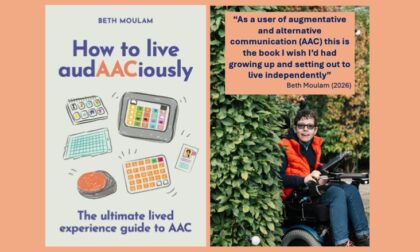
First, I needed to decide what I did and didn’t want for my future. I already have some documents outlining the support I need on a day‑to‑day basis, and since COVID, I have kept a detailed document covering my medical needs. I also have a chapter in my upcoming book, ‘How to Live AudAACiously’, about using AAC in health and care settings.
Based on all of this, I set about adapting what I had and soon found myself adding all sorts of personal information, e.g. if I am in hospital, I must always have access to my AAC devices, which must be charged overnight. I have even noted which arm any cannula must go in and how my arm needs splinting so I can continue to access AAC.
Some of the communication requests are based on ‘what if this happens’ scenarios. For example:
- Having the input from a specialist AAC team from the Regional Assessment Centre. This would be important to ensure that, if I cannot access my iPad to communicate, mounting is provided for my eye‑gaze in a hospital bed.
- Not being expected by consultants, hospital managers or others to undertake an assessment or make ‘life‑changing’ decisions without my family or a trained communication partner of my choice present, and if necessary my attorney.
- For any prolonged hospital stay, the ward team and other key professionals should receive communication‑partner training.
- There were plenty more!
Alongside these wishes, I have noted why each request is important to me and how it can be achieved.
But more than this, I have thought about what steps I might want to take regarding my long-term care, my desire to recover in my own home rather than be placed in a care/nursing home, what I feel about Do Not Resuscitate notices, and more. None of us have a crystal ball but I also thought about the differences between consent, compliance and being content under the new definitions around potential deprivation of liberty (DoL).
How do I feel now that this is in place?
I’m feeling reassured and relieved that I have taken action. It hasn’t been easy, and I know that, in the long term, we need to see how the DoL changes pan out. I’m still in the final stages of getting all the paperwork in place, so it hasn’t been a quick or straightforward process.
What are your rights?
Meanwhile, I’ve also created a document using my policy hat. This is ‘Your rights as an AAC user: A resource for AAC users, their families and support networks – The Mental Capacity Act, Deprivation of Liberty and Safeguarding’. This is quite a chunky guide written from an AAC user’s perspective, pulling the things I think are important into one place.
These are my personal views. I would recommend that if you have concerns, you take professional advice about your own circumstances.

If you found this interesting or
helpful please feel free to share.