
Communication, hearing impairment and lip reading 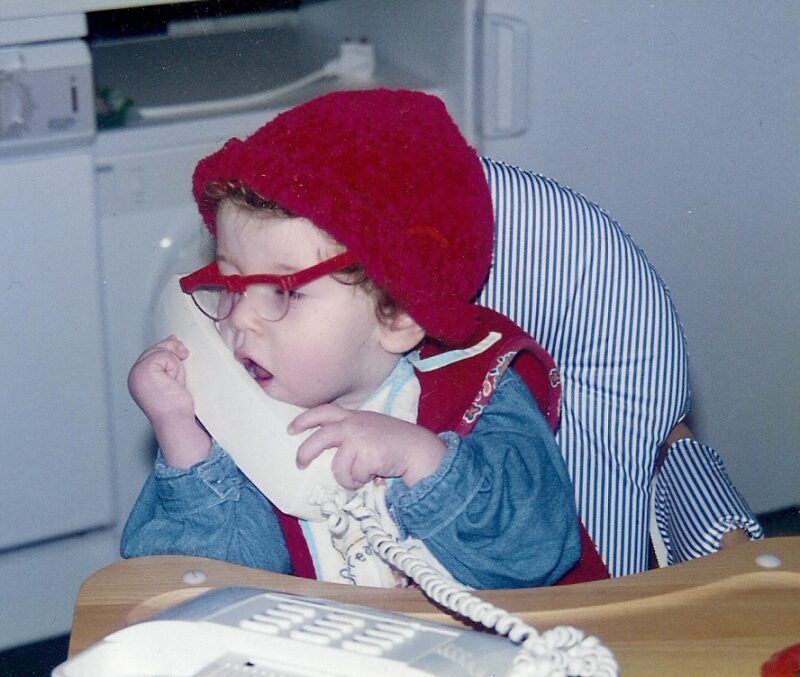
My hearing impairment was monitored from a very early age due to my cerebral palsy. I don’t think my parents or I realised I was partially deaf. We didn’t know what I wasn’t hearing, although we had early guidance from the teacher for the hearing impaired. This intervention reduced distractions and background noise around the home. But not hearing didn’t stop me from wanting to always be communicating.
Hearing, listening and interpretation
When you have a hearing impairment, receiving information and interpreting it is key. Hearing and listening are two different things; hearing just happens, but listening is an action. I didn’t have hearing aids until I was 10, so I relied on multiple inputs like observation, lip-reading and body language. I realise now how many interactions I misinterpreted and how much information I missed. For example, thinking my new neighbour was called Berry, instead of Beryl.
Digital hearing aids
I was 10 when digital hearing aids became available through the National Health Service. Suddenly that’s when I learned what I’d been missing out on. Up to that point, apparently, I had heard about 70% of what was going on around me. I have a high-frequency hearing loss and a generalised loss. The high-frequency sounds I miss are called fricatives which are ‘s’, sh, ‘f’, ‘v’ and ‘th’. In addition, the generalised loss is everything below a certain sound threshold. If you can, imagine saying to me ‘the sun is shining and the sky is blue’. What I hear is ‘- eh un i ining and – eh ky i blue’. It takes quite a bit of untangling for me to get the right meaning.
Lip-reading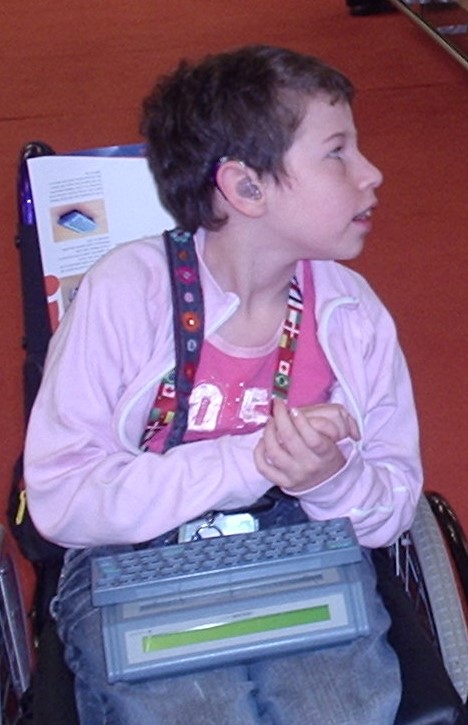
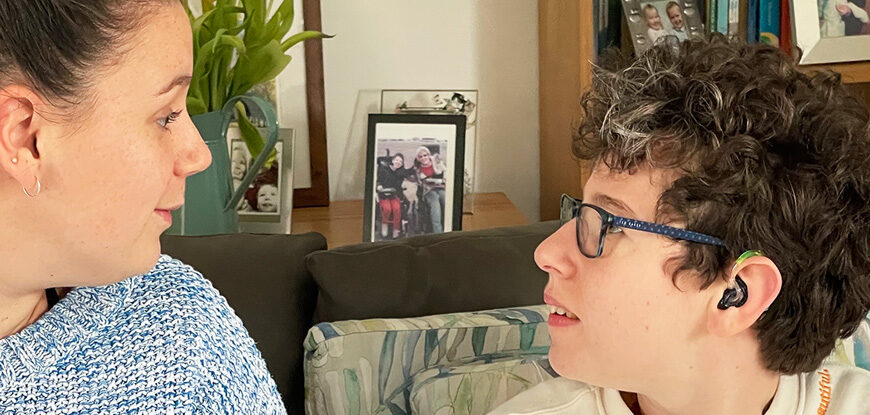
I didn’t realise that lip reading was unusual until I got my hearing aids; I’d done it for as long as I could remember. In fact, I just took it for granted everyone else did it too. Because of that early guidance, my parents always made sure they had my attention before they spoke. They made sure they faced me, and I guess, as an only child, our conversations were mainly 1 to 1. In school, I was always sat at the front where I could see the teacher. In addition, I had a 1-to-1 teaching assistant at all times; again, we were sat so I could always see her face.
One clue looking back that I had a hearing impairment might have been I never wanted to watch cartoon-type videos (apart from Tom and Jerry). I’ve always preferred videos with people where I could see their faces when they spoke. It felt like my whole world opened up when we got DVDs with subtitles; I just loved that.
As a teen, I went back and bought all the Disney movies with subtitles. Not surprisingly, you can imagine they made so much more sense than watching them in near silence. Another clue might have been how I struggled in class if we had a supply teacher, especially if they spoke facing the board, had a new accent, or had a bushy beard!
Being partially deaf what I’d never heard before
Getting my first hearing aids was exciting and unnerving; I had no idea what to expect. They were switched on, and everyone sat quietly. They asked what I could hear. My first comment was, “What was that noise outside”? It was birds singing; WOW, I never knew. My memories of those early days are gravel scrunching underfoot, a plane going overhead, more birds singing, and feeling exhausted! At that stage, I was suddenly hearing around 90% of what was happening around me. I felt under assault from all the different sounds, and I kept having to ask what ‘that’ sound was. Fortunately, it was the beginning of the school holidays, and by the time I went back to school I was ready for the next stage.

Changes at school
My teacher was given a microphone to wear, and everything she said was transmitted to my hearing aids. Whoa, this was full on! She had to remember to switch off if she was talking 1-1 to someone else; otherwise, I heard everything. Suddenly I couldn’t daydream or switch off; I had to pay attention to everything being said, and I felt invaded. The best bad experience was the male teacher who popped off to the loo and forgot to remove his mic.
Learning I could be in control of what I heard
Over the next few years I was given upgrades as new digital hearing aids became available. And, over time, my hearing impairment has deteriorated somewhat. By the age of 16, I got a pair of aids that meant I heard around 97% of sound. It was only when my friend Mel came to stay I realized I could get a controller to turn down the sound, because she had one. The downside was that in school I had to ask for this to be given to me, so people knew when I needed to zone out.
Strategies to learn new vocabulary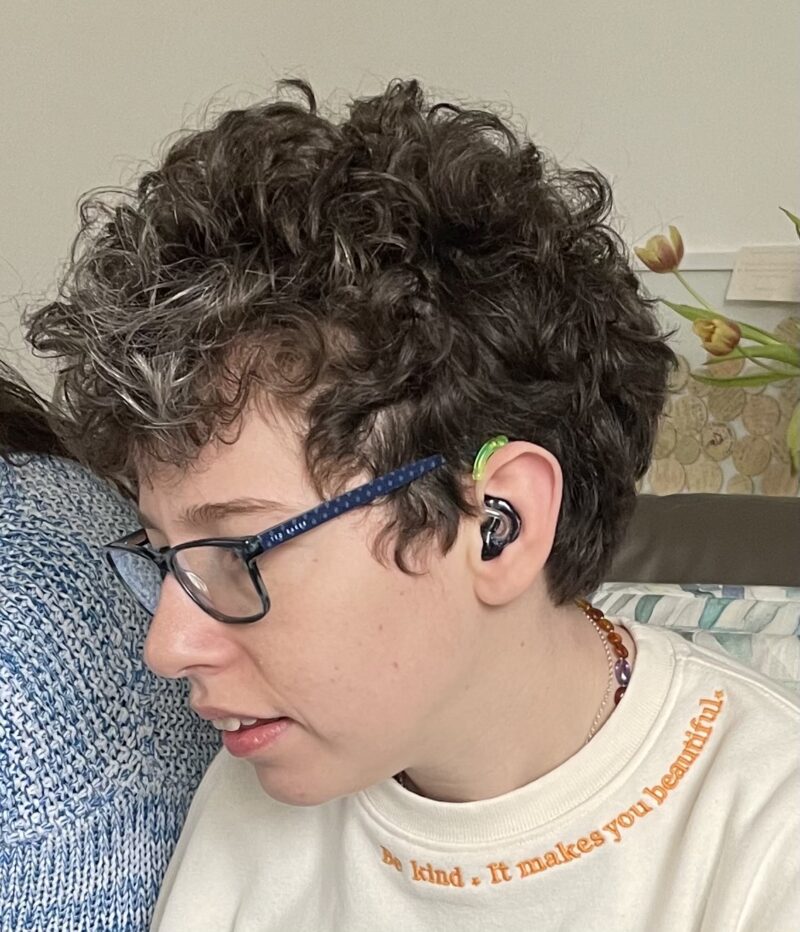
At around that time, I also got new guidance from the teacher for the hearing impaired on how deaf people learned vocabulary. Within 4 months of getting these new hearing aids and employing these strategies, my reading age went up by 4 years to being age-appropriate. A by-product was that my spelling really improved; then so did my speed of programming my communication aid. Even today, when I hear a new word, I need to unpick it to learn it; being unable to sound things out in my head makes this vital if I’m going to learn it and use it. I learn every word as a whole word shape. My steps are to hear it, lip-read it, write it in lowercase and see it on my communication aid.
Extra clues to comprehension
I’m a visual thinker (see my stuff on synaesthesia) and my brain has been patterned to lip-read. The result is it isn’t something I’ve ever been able to switch off. Watching a speaker and observing their facial expressions and body language has always helped me understand what is being said. When I miss tone (a bit like using AAC to speak), I need extra clues to interpret the emotional intent of the message.
Resting my brain
As an adult, I now choose to have some time at home when I don’t put in my hearing aids. This just lets me be in a quiet place and be me. We all need to relax, and it gives my brain a chance to switch off once in a while. But I wouldn’t be without hearing aids for everyday interactions but chillaxing on my own is a different matter.
9 tips when communicating with someone with a hearing impairment
- Always make sure you have the person’s attention before you start communicating.
- Don’t speak to them from behind; always be in their line of sight and turn your face towards them so they can see your lips.
- Check that they can hear you and that what you are saying is clear.
- Please don’t stand with your back to a window; this puts your face in the dark, making it harder to lip-read.
- Avoid talking in noisy or distracting places, e.g., with a washing machine running, the TV on, or in a busy coffee shop.
- Always use plain language and be to the point.
- Speak normally, trying to be clear with your speech, facial expressions, and body language, but don’t overemphasise.
- Never raise your voice or use excessive body language; this might appear aggressive or rude.
- Don’t hold your hands or an object in front of your face, as this can block your lips and expressions.
If you found this interesting or
helpful please feel free to share.