
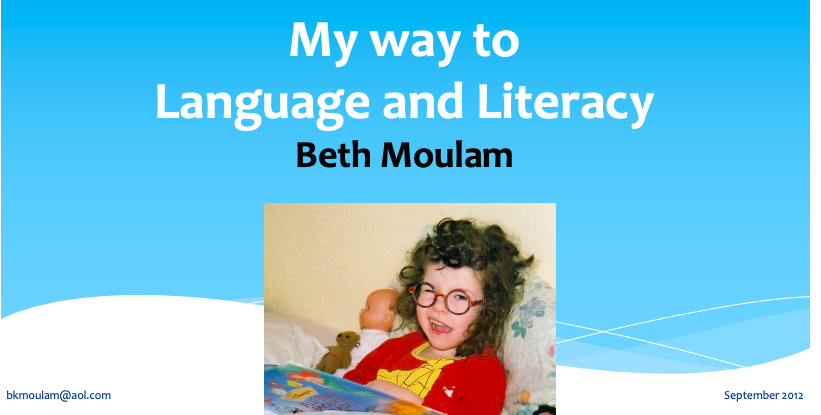
Recently, I received a question about my primary school AAC journey and how this prepared me for transitioning to secondary school and adult life. This set me off thinking about the purpose of education, curriculum access and my own primary school AAC journey.
Education aims to equip all young people to take their independent place in society. To fulfil their potential, become economically active, contribute meaningfully to their community, and support their future family.
Until now, some children using AAC have not had equal access to the national curriculum. In many cases, this may have been based on myths, assumptions, and prerequisites for learning (not discussed today!). Some, like me, have been fortunate to receive AAC ready to start school, but most definitely not all.
AAC users are no different to other learners
In my humble opinion, an AAC user really isn’t that different to any other learner. Most children arrive at school with a clean slate. There are no labels or preconceived ideas about how they will participate or whether they can learn. As AAC users, we may need adjustments, yet so do others! From those with specific learning needs through to those who are gifted and talented. The journey to independence for every child starts pre-school at home. Formal early years and primary school learning begin to mould children into what society expects and needs of its future citizens. For all children to become independent, literate communicators.
When the multi-disciplinary early years team have had the opportunity to be involved, a child with little or no speech may arrive at school ready to access the curriculum. There will be tools, resources and possibly additional 1-1 support in place. Please note the if and should – there are lots of reasons why this might not have happened. I am conscious that some children may take longer to learn or achieve different outcomes for a variety of reasons, but every child should be allowed to develop and fulfil their own potential.
Evidence now shows there is every reason to have the same high aspirations for AAC users as for other children; many AAC users who emerge from the education system go on to university and access meaningful work opportunities. Yet, when we listen to them, we often find that many were not given the same early opportunities as their peers. Assumptions were sometimes made that delayed their learning, but despite this, they’ve found ways to achieve success and become both good communicators and literate.
Factors for AAC user success
My own dissertation research suggested professionals believe the common factors for AAC users to be successful are threefold:
- Early identification of need and prompt provision of resources.
- Families and the multi-disciplinary children’s workforce, including teachers, who are advocates for AAC and believe in individuals seeing their potential as learners.
- A multi-disciplinary support team that has high expectations, provides consistent and knowledgeable ongoing support, encouraging the AAC user to grow.
Communication and literacy are different
Building resilience as an AAC user matters. Being empowered, learning to take risks, and staying motivated to rise to the challenge of fulfilling your own potential are essential. Of course, every child has an individual journey because none of us has the same destination. However, when another child speaks, we don’t usually focus only on verbal communication or stop teaching them when they can make basic requests or express fundamental emotions. Literacy is the tool that empowers the AAC user to communicate to the best of their ability.
Literacy is the ability to read, write, speak and listen. Digital learning, one of the key elements of the Government’s plans, is about investing time in the use of technology to promote learning. Here, AAC users already have an advantage: with their own bespoke communication technology, already set up for their needs, the tech is ready to go as an alternative pencil for learning to be literate.
Being literate is more than just learning the alphabet or spelling our own name. All the latest Government proposals talk about inclusive education, high standards for all, including teaching literacy and digital learning:
- The Reading Framework (2023) says all pupils, including those with additional needs, can learn to read, with the possible exception of a few children with a PMLD label.
- The Writing Framework (2025) likewise states that all pupils can learn to write, although it suggests that some children can use digital devices for written composition; they should still learn to handwrite. A possible exception may be made for some children with a PMLD label.
Evidence from successful AAC users suggests that both the reading and writing guidance will be a robust strategy. However, the guidance on exceptions must be viewed with caution; using or needing AAC should not be an excuse for not teaching reading or writing, for lowering expectations, or for justifying when things are not going well. Every child deserves the opportunity even when it takes longer to progress.
When we talk about all learners, this means everyone, not just some children, but all children, including those with a SEND label and especially AAC users. To do this effectively, AAC users, including those with the most complex needs, must be given active opportunities to learn all these same skills.
To answer the question about my primary school AAC journey
When I started mainstream primary school in 1998, there was no blueprint for teaching AAC users. Nearly 30 years ago, we were breaking new ground. I was one of the first to get powered AAC in the country. The result was that I was taught the same way as every other pupil in my class, with the same high expectations, except for an initial blip. I was privileged to have access to conventional literacy teaching; it was assumed I could and would learn like everyone else.
Literacy: the greatest gift
I’d started reception class able to sight read, apparently already ahead of many of my peers at nursery. Sadly, the class teacher couldn’t understand me, so she put me back on picture books. That soon changed after Mum referred them back to my pre-school teacher’s report, and my teaching assistant grew accustomed to my unintelligible dysarthric speech. They couldn’t always understand what I said but they could tell from intonation and pace I was fluently reading. Then they had this confirmed as I could answer questions about the text.
At around 7 years, school suggested I was restricted when it came to answering questions about what came next in a story. Rather than giving up, my Mum took this as a challenge, and we spent time developing this skill. First, by ensuring I had the vocabulary to express myself in new ways. Then, secondly, by discussing different options and outcomes for everything I read to build my confidence.
At a similar point school also suggested I was not very creative. It became clear that the issue was access to vocabulary: if I wanted a word beginning with b and it wasn’t there, I was forced to choose something I regularly used that had a similar meaning. Around the same time, Mum also taught me the power of open questions. Initially, this was to help me develop more proactive communication skills; however, I now draw on it daily in my written work as well. She explained to me the difference between closed quick questions, which were boring for us both, and how to get a full response. Using who, what, where, how, why and when questions became second nature at home. They became great levers for developing a storyline or thinking about what next.
Reflecting back, when it takes longer for an AAC user to do everything and time is limited in school for tasks. I often didn’t complete the work, and it is important to acknowledge what might get overlooked, e.g., reading was slower, so there was less time to discuss the text.
For me, the greatest gifts I left primary school with were to be both literate and have good functional communication skills. Thank you to everyone who thought I could! Literacy empowers communication throughout life. If you use symbols and don’t have the word available, unless you find a different one to make yourself understood, you are stuck. When you know the alphabet and can spell, then the world is able to hear whatever you want or need to say.
A letter board or keyboard saves the day every day.
Listening to language matters
Language has always been important, too; I loved story time and books even before I started school. Hearing words and painting visual images in my head is brilliant, but active engagement is important. Language is built by seeing, understanding and using words. I’ve been an avid book reader for as long as I can remember. My parents read to me every day since I was a baby. I have always associated the spoken word with print and pictures in my head. At around age 7, I began listening to audiobooks at home, following along with an unabridged physical book (page turned by an adult who ran their finger along the text being read). I would indicate when to stop when there was new vocabulary I wanted to understand, and we then discussed it. As I grew older we would also stop the tape (CD’s didn’t yet exist) to discuss similies, homophones and other things being taught in school.
But language has been so much more for me. I’ve always been a deep thinker and problem solver. I spend a lot of time pulling apart concepts and building ideas in my head. From experience, I know many disabled people do this; we are tenacious problem solvers. We cannot always easily do what is expected of everyone else, so we find our own way. At home and with my therapy team, I was asked for my ideas and solutions. I was lucky that school were nearly always willing to listen to what was working rather than assuming they knew what would work for me.
Embracing technology to write
I’d been trying to write since before I started school, but preferred to use my toy computer or go on the desktop with Mum. Holding a pencil was pretty hard. I could write a few letters, but each one was bigger and less formed than the one before it. After only 2 or 3 words, my hand control meant the letters were scrawled across the page. When school noted I formed some letters incorrectly, either backwards or in the wrong configuration, we set to work to remedy this at home. I believe it was right to know how to form the letters, but once I knew that, not being able to physically form the letters shouldn’t stop progression by using alternate pencils.
Initially, I typed my own work, but this was slow and laborious, and as the expectations grew, my teaching assistant became my scribe. My early experiences with technology began long before I started school, because we had a home system. Then, having my own computer in the classroom when the only other one was in the school secretary’s office gave me a huge advantage when computers were first introduced into the classroom in Year 5, when I was 9. By then, I was already digitally literate and ahead of my peers; this played to my strengths.
I had only ever needed to be shown something once, and I was off; I could easily access the settings on my AAC device after observing others programme. From around age 6, I was adjusting the settings to suit me and never telling anyone! I only once did too much and needed a factory reset, which taught me a huge life lesson: Change one thing at a time until you know it works. I was also the person to ask if there was a problem with my device; I could troubleshoot many minor issues, rather than an adult taking it away, perplexed.
We may all learn differently
I wish I’d known in primary school that I was processing everything I was learning differently from others. And, I wish they had known too! Due to my brain damage, I have visual memory. Everything I read and hear is turned into consistent colourful images, drawn from my early symbol set, a standardised letter set, photographs, visuals in the environment and more. I often describe it as a glorious technicolour action film reel that whizzes through my head. To read, I use whole word recall with standardised colours for each letter of the alphabet. When I spell, I see the shapes and colours form as the letters. I learned at university that I learn best when I read and listen at the same time; it is faster to visualise a concept or word when someone reads aloud, or when I listen to a text reader, than when I read alone. You can find out more here.
Because I don’t think in words, I understand now why I found it difficult to read silently in my head from around the age of 8. People kept saying ‘listen to the words’, but I didn’t have them, and because of my hearing and dysarthria, I cannot sound words out. I turned this around in my mid-teens with improved digital hearing aids. At this point, I started to hear much more of what was happening around me, and I realised my inner voice was made of images. Meanwhile, my learning in primary school hadn’t stopped; I just couldn’t consistently demonstrate, in the ways they expected, that I was developing the same way as others. In hindsight, maybe there should have been more exploration of why I wasn’t making progress in silent reading, rather than assuming it was possibly because I was an AAC user.
Recognising the importance of different learning strategies
What I never understood was having to demonstrate my learning differently to others. I was typing my work with text, and later working with a scribe who typed text for me. Yet I was expected to use symbols to speak, not always having the vocabulary I needed. I was fortunate that at the age of 7 I found word prediction, text with the symbols, when playing in the back of my AAC device. By then, I could always start to spell a word and play with the shape and colours of the letters until it was spelt right.
Setbacks and opportunities
You can find out more about my communication journey here. My one word of caution is: never change an AAC device without considering what the change will mean. At 8 I was moved from the device/software I’d had since age 4 to a different one because it was thought longer term it would be beneficial. It was a smaller device that could act as both a laptop and a communication aid. What no one predicted or understood was the devastation of losing my symbol language overnight. Suddenly, all my personal and social narratives disappeared. I had to learn new symbols and new navigation to speak. Then, for written work, I had to switch into yet another different symbol package. You could liken it to arriving in a foreign country, able to understand the spoken word but not able to speak or write it.
By 9 I had a text based system that really improved my spelling as I was so determined to use it, and it only predicted words once you’d used them! The emphasis was on my spelling it correctly the first time, as incorrect spellings were also predicted.
School was good at finding alternative ways of working. When new special-needs software was introduced to make work accessible for me, they often then used the same worksheets for my peers, too!
Using AAC is a very different way of learning
Communicating with AAC is a cognitive and physical process that is often slow and deliberate. The mental load really is twice that of other children. We are taking in what everyone else is expected to do. Translating what we hear into our way of processing. Then, physically outputting it in a way that others can understand in a format they expect. This really is, in my mind at least, equivalent to working in a second language when:
- You translate from the foreign language into your own language,
- Formulate the answer,
- Translate back into the second language,
- Rehearse as you go before speaking.
The physicality of communication
Yet what hasn’t been recognised in the second language analogy is the physicality of communication as an AAC user who needs to:
- Sustain motivation and hold the task in working memory whilst doing other tasks,
- Navigate to the right place, which will be a conscious task, possibly through layers of pages,
- Recognise the symbols, words or letters in your system or on a keyboard,
- Select the words needed and place them into a speech bar or reader.
- Then output the message.
Learning to write by using a scribe is also a special skill set; you have to organise your thoughts mentally, formulate a response or construct an utterance before starting to physically input into a communication resource. I’m told that when speaking, people’s words are constantly evolving as they flow out of their pen, yet if they try to dictate, they often stumble over words.
All of this zaps energy. One thing I wish people had understood was what was draining and why. Then, how to balance energy when asking me to do something important, so I had enough energy for the day.
Learning to use AAC takes time
There are loads of different views on how long it takes to learn to use AAC. I received conventional literacy teaching, but my specific communication learning was hugely supplemented at home. In reality, AAC users need to be taught both communication skills and literacy skills in school, not one or the other.
In my experience, I equate becoming an effective AAC user with learning to be an elite athlete. Research cites that 10,000 hours of practice are required to become an expert or world-class performer in any skill. As a Paralympian, I trained for hours every day, across years, to become worthy of representing my nation on a podium. Another often-cited analogy is that learning to use AAC is like becoming a classical pianist. We expect all children to play sports and to listen to music before beginning specific training. Likewise, all children absorb language in every waking hour, and so do AAC users. Yet, we don’t expect typically developing children to speak in perfectly formed, grammatically correct sentences at 2, 5 or even 8. But if an AAC user gets the right support and equipment, then the gap between them and their peers is narrowed from the start, and there is the greatest chance of fulfilling potential.
Nevertheless, we should remember that using AAC adds an extra layer of complexity to learning; this means that when an AAC user is doing the same as their mainstream peers, they may actually be ahead of the game.
Thinking time and leaning into the silence
For an AAC user to output anything, it does take extra time. My teachers were receptive to learning themselves and were willing to discuss techniques to support me (Mum was doing an OU psychology degree at the time). They agreed on the importance of preparation time and that, in the class, others would also need additional thinking time. Then, when working 1-1, they should learn to lean into the silence and give me time to think. That meant I could programme my best response without feeling anxious; stress always made my body tighten and made inputting harder. See my post about thinking time.
Quality of communication
My head has forever been full to bursting with ideas, thoughts, wishes, dreams and questions. School can be a difficult place to share these; the structure and routines of formal education don’t often allow much time for sharing what’s going on in your head that isn’t about the task in hand. Break and lunch were about eating, yet AAC users need the same opportunities as others to chat, socialise, and share what’s on their minds. Finding the balance for everything was always tricky.
AAC is for life
At the end of the reception year, the Local Authority AAC consultant threatened to take away my AAC device as staff weren’t using it with me; it was too slow, and they had got used to my non-verbal communication. If someone didn’t understand, they relied on the teaching assistant to translate. After that, everyone tried harder, but it was only when I was 9, and we started (early) considering secondary school placements, that AAC was taken more seriously by everyone.
Both Mum and the AAC consultant explained that AAC is for life, that outside of school, I was using it with those who didn’t know me. I was also using it at home to say something out of context to cue my listener in. Staff needed to recognise that at secondary school, no one would know me, so I would need to use it all the time. I needed the same preparation as my peers to be as independent in my communication as they were, and it was essential to build communication resilience. From that point on, my device went where I went. They started sending me to the school office with messages like everyone else, and preparing me for the transition to secondary school.
Setting my own expectations
Primary school set for me the benchmark for what to expect in school and later adult life. That adaptations and adjustments are essential for access to the curriculum, but with extra time to complete work, I could be taught the same as all other children. There should be high (and realistic) expectations of me. I should be respected by my peers, not patronised by staff or talked over; everyone should give me time to get my message across, and I should always be included.
Home school working
I’m the product of those early years. The staff and my Mum were often breaking new ground in how to approach things, challenging the standardised way tests should be administered. For example, the speaking and listening component of KS1 and KS2 tests posed the most significant challenges, but by the time I got to KS4, the English teacher at my special school had it sussed. These days, good guidance exists for KS1 and KS2 assessments.
For some one-off activities, the school would borrow equipment and resources from home, and, where needed, I was allowed to load a school programme onto my home computer. Programming was shared with my school doing curriculum pages and Mum doing the more social side of things. (Recognising that this won’t be possible for every child/family).
In hindsight, there was a massive amount of cooperation between home and school. They shared overviews of lesson plans, so Mum had context when I wanted to talk about what I was learning. Without quibble, they wrote in my home school contact book daily. We probably took much of this for granted at the time; it is only when you realise what happens to others that you can value your own experience.
Luck, chance and opportunity
I may have been lucky with my primary school AAC journey and fortunate to have parents who gave me every opportunity. However, I firmly believe in potential; the potential we can all learn. If every child who needs AAC is identified early, has the resources they need before starting school, and receives the right ongoing support, there is no barrier to any AAC user fulfilling their potential.

If you found this interesting or
helpful please feel free to share.