
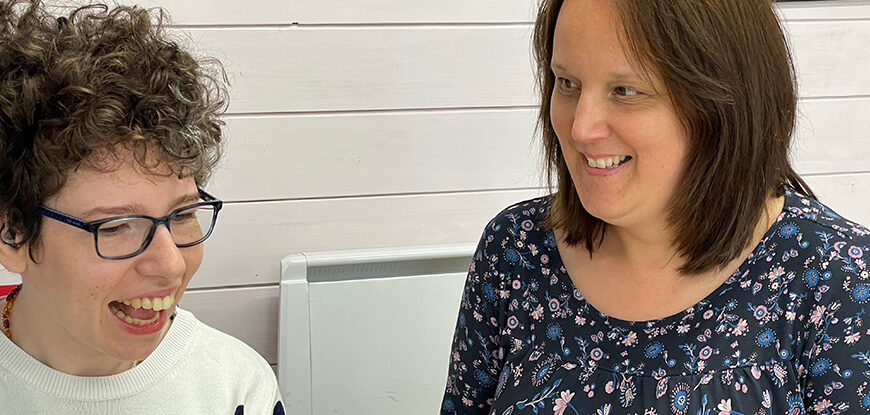
I feel the key to good communication is having a skilled communication partner. Whether we use AAC or natural speech, the best interactions are with people from all walks of life who demonstrate active listening skills, show patience and curiosity, and model excellent communication for others. In any interaction, there is a giver of information and a receiver of the message. When you have difficult to interpret speech like mine, or use a communication aid, it is important for a communication partner to demonstrate they have understood correctly what is being conveyed and help others feel relaxed talking with you. This page includes active listening tips that help avoid communication breakdowns.
Good communication partners are active listeners.
For me, an active listener isn’t just hearing what is being said. It means really listening, paying attention, being aware of my body language and facial expressions, showing patience, and demonstrating understanding to create shared meaning.
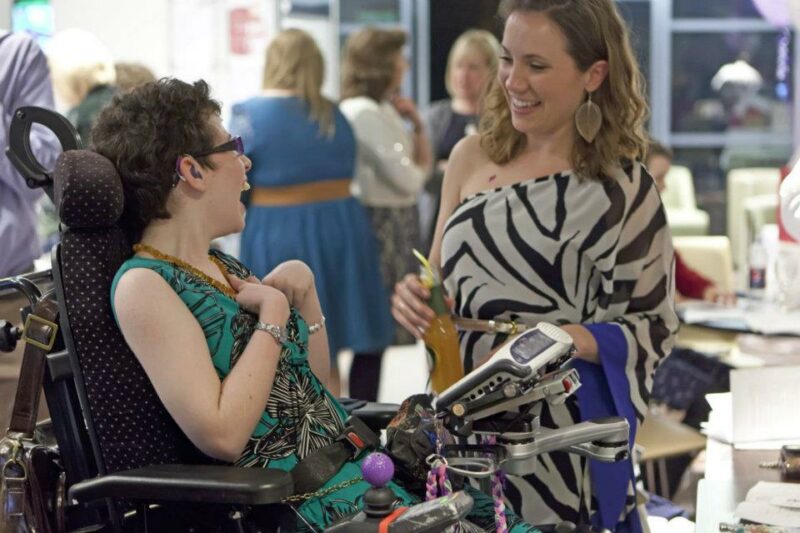
Skills demonstrated by active listeners
When someone new starts working with me, I provide specific training. It’s important they become great communication partners quickly. The key is developing active listening skills, which in turn builds patience. Sometimes this skill takes time to develop, and other people already have these skills but maybe don’t yet realise it. Making people consciously aware of these skills is really beneficial.
Listening to understand, not to respond
It is all too easy to listen to respond, jump in and misunderstand. In day-to-day interactions, I like communication partners to demonstrate that they have made a conscious decision to listen to me by:
- Stopping whatever else they are doing.
- Giving verbal affirmations that they are listening, such as saying yes or mmm.
- Demonstrating non-verbal clues such as a smile, nod, eye contact, modifying their posture (lean in or to side), or mirroring facial expressions.
- Avoiding distractions such as looking at their phone or watch, doodling, or fidgeting. Although I do accept that some people listen better if they can constantly move.
Reflective listening
Because I also use verbal communication, which is often unclear, I like my communication partners to demonstrate some empathic listening skills. In the early days of working together, this means I like them to mirror what I am saying. They do this by repeating each word or short phrase to show they understand. As we grow more confident together, we move to paraphrasing, where they might not repeat every word, but instead use keywords or give a brief summary . The importance of both mirroring and paraphrasing is not judging what I’m saying or asking questions, but showing comprehension before responding. There is nothing worse than someone who misunderstands and rushes off to do something you don’t want or need!
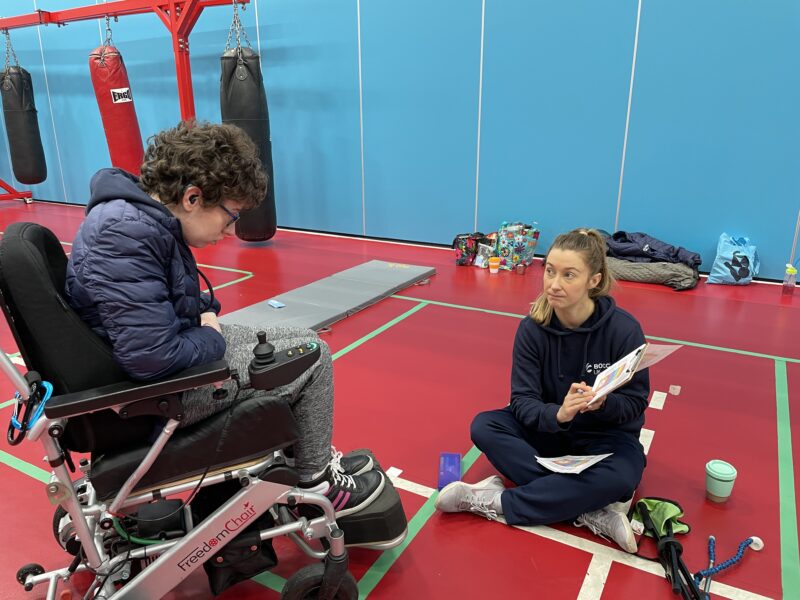 Interpreting emotions and feelings
When I was younger, I didn’t have the emotional intelligence and vocabulary to explain my feelings. In the early days, I found it useful for my communication partner to support their understanding by interpreting my body language, alongside the words I was saying. A good way of doing this was assessing the intensity of my emotion on a scale of ‘you feel’ a little bit, quite, a lot, really, very…..
Providing thinking time
In my blog post Thinking time or a mind blank, I also explain how my mind works. As a visual thinker, I need a communication partner to give me a second or two of thinking time to process my thoughts. As both a verbal speaker and someone who uses AAC, it isn’t always easy to retrieve and physically convey what I want to say without considerable conscious effort.
Passion versus chunking
I can sometimes get carried away when I am passionate about things. This means I barely stop to breathe and just keep talking. Unfortunately, this makes it harder for my communication partner. At times like this, I need to inhale, then remember to chunk. Chunking is saying what I want in smaller sound bites, something easier for the listener to process. I also know I might need to use my communication aid, but again I need to chunk. This matters because listeners can only hold a finite amount of dialogue in their working memory. Programming spontaneous speech can be time-consuming, and communication partners can easily switch off if they are waiting too long for a message to be prepared.
Key to good reflective listening:
- Be natural.
- Listen to the basic message – Content, Feelings, and Emotions.
- Reflect back in a simple, clear fashion.
- When mirroring or paraphrasing, check my body language and verbal cues to confirm you’ve understood correctly. I may not want to disagree with you.
- Don’t question, add, embellish or interpret whilst you listen.
- Avoid deflecting to a different topic; stick with the point I’m making.
- Remain non-directive and non-judgemental.
The right to free speech
It is always tricky when asking a communication partner to translate. I prefer it when they repeat what I am saying verbatim. This strategy works well because the listener has already heard me say it, and the intonation of the repetition mirrors my output. It also gives the listener confidence that the translated answer is mine.
Active listening is only the start, or a part, of any interaction
I hope and expect my communication partners to have meaningful and purposeful conversations. This means that, besides active listening, they can probe for information, clarify what I’ve said, and summarise a point. In any two-way interaction, I expect to also do the same. For instance, by asking them questions, listening to their reply, seeking more information, and showing I’ve understood.
Modelling good communication skills
Many people can be afraid of talking with someone who uses AAC. It can also be challenging for someone to approach my communication partner and me in new situations. To help people feel more comfortable and know what to do, we make it our personal mission, when out and about, to demonstrate good communication skills. We do this by modelling the skills we know are important. Below are lots of different resources with tips on how to do this.
6 Resources I’ve made to support communication partners
- What I like and dislike about being a communication aid user https://www.youtube.com/watch?v=-YFnV0IWBUg&t=55s
This was my first ever AAC video, made when I was 11. It all still rings true today. And listen up, when I first got my communication aid they all had American voices, fortunately, that’s not the case these days. - ‘Listen to Me’ Video
A collaborative 1 Voice teenage production. My friends and I made this DVD in 2006 to share with people how we would like to be communicated with. I can’t believe how young we all looked. https://www.youtube.com/watch?v=9Cw2Fp_TIfc - How professionals can help young people who use AAC
Professionals play a big part as communication partners in the lives of disabled young people. Here is my dress rehearsal for the 1 Voice Presentation at the Communication Matters conference in September 2009. I was asked to speak about how professionals can help young people who use AAC http://www.youtube.com/watch?v=anO37UysrPM - The importance of role models
I’ve been lucky to have had great role models who use AAC since I was around 8 years old. Mostly they have been people I met at 1 Voice and then at the ISAAC conferences. Toby was my first AAC role model, in 2006 I nominated him for the BT ChildLine Superhero Award which he won. This is what I said about him at the time http://www.youtube.com/watch?v=vZj6so6Ryi0 - Multi-modal communication
I sometimes think I’m labelled as a high-tech communication aid user, because that is what is visible immediately. However, in reality, I use lots of different ways to communicate. This short video made in 2009 shows How I communicate - Moving onto university
Transitioning to university meant finding new communication partners. I created this short video when I first went to university to be shared with staff and students on my course. Before starting it became obvious some people were a little anxious about working with me. As a result, this was my attempt to share that just because I have a disability and use AAC, I’m no different from everyone else.
10 ways to support learning to use an AAC device as a communication partner
My Mum found something similar to this when I was 5 or 6, and adapted it for me. It hung on our wall at home so visitors could get some tips on the things I liked and that supported my communication. Whilst everyone is different, these 10 points still resonate with me today as good protocols for communication partners.
- Please be patient
I like it when you take time with me. Communication is hard work; it takes me time to find the words I want to say. Using AAC is like learning a new language, and so I have to think very hard to find the words on my device. - Look at me when we talk
It is nice to know that you are interested in what I am saying. My head might be down whilst I am programming, but I like it when you are paying attention to what I am doing. It helps if you are at my level. Your being positive encourages me to keep going. - Let me finish my own sentences
It feels good when you don’t try to guess what I am saying. I like to finish my own sentences, even if you think you might know what I’m trying to say. Indeed, I also like it when you wait and don’t look over my shoulder whilst I’m programming. - I like it when we take turns speaking
Thank you for listening to me; it makes me feel really good when we take turns to talk. I also like it when you ask open questions, ones that start with who, what, where, when, how, or why. It is boring if I only get to answer yes or no, although there is a place for closed questions. - Allow me to answer for myself
I value your input when you model good communication with me to other people. This helps them know what to do when they are with me. Thank you for not answering for me. - Show that you understand what I am saying
I like it when you confirm you have understood what I am saying. If you rephrase it, I also learn other ways to say the same thing. I can tell when you don’t understand me, so I’d prefer you not pretend you do. - Remember, all communication is multi-modal
I really like it when you watch my facial expressions and body language for clues, as well as listening to the words I say. If you need additional help, I can show you with gestures, my eyes, by answering questions, or by using props around us. - Help me to stay calm
I’m grateful if you realise I am struggling and help take the pressure off. Sometimes I can get flustered when I am asked to use my device, especially when I am tired or need a break. - Sometimes I need a break
I appreciate when you recognise I am getting tired; communication takes a lot of energy. I can find it hard when I am hungry or tired. And I like it when you ask me if I want to come back to something later. - Treat me with respect
I like it when you praise the effort I am making and encourage me to keep trying hard. I’m not a baby so I appreciate it when you talk to me like I am my age.
You might also enjoy reading:
AAC, video conferencing and communication partners
Boccia and Teamwork, no communication allowed
Thinking time or a mind blank?
If you found this interesting or
helpful please feel free to share.