

I’ve always dreamed of helping others communicate.
When I started school in 1998 I was provided with an electronic communication aid that was bigger than me. It was a profound moment to realise that when I pressed the symbols that represented what I wanted to say and then the speak button everyone could understand me. From that first day, aged 4, I wanted to grow up and be like my AAC consultant. My wish was to give other children like me a voice, whether that is using AAC or being able to share their views and opinions in writing.
 Communication is a fundamental human right, or need
 Communication is a fundamental human right, or need
I wasn’t old enough at 4 to understand communication rights. But the desire to empower others to share their views, opinions, needs, wants, and feelings with those around them has never waned. Having the confidence, right tools, and resources to communicate should mean being able to enjoy equal rights. As an equal member of society you should be able to take part in every area of life, in the same way as everyone else.
To find out more about the right to communicate and AAC policy click here.
Learning to love AAC at home
I didn’t always use my communication aid much in the early years at school. Mainly because it was for me really challenging to spontaneously output what was needed alongside being in fast paced learning environment in a mainstream classroom. Most early devices use symbols and also have the word written under them, but in those days no-one had heard of modelling. I always knew what I wanted to say but it took me ages to navigate to the words I wanted and by the time I had got there the moment had passed. My first device was also so big it was not easy to move around the classroom.
When I was 6 my mum insisted on my communication aid coming home from school every night. Because of this, it became something I became confident using with communication partners mainly at weekends and in the holidays.
Fortunately, by the time I left primary school technology had improved. I had a laptop and a much small communication aid that slipped inside Mum’s ‘kitchen sink’ handbag when we went out. In primary school I didn’t have a power chair, instead I used a walking frame. To start with my device wasn’t mounted on my power chair, it just sat on my knee. AAC should always be available to us in every situation, even if we choose not to use it. I believe the support I received at home was, and still is, fundamental to me having become a proficient and successful communicator.

I can even ask a reliable communication partner to re-voice what I say, or to even expand on one of my stories or experiences they already know, to save me energy.
It is important to realise multimodal communication is not one method or the other, either, or. In every interaction we all draw on multiple strategies, often at the same time, to get our message across.
Multimodal communication is dipping in and out of any appropriate communication technique as needed, every form of AAC is a valid method of communication whatever and whenever we chose to use them.
Paper based AAC resources – Letter card or alphabet board?
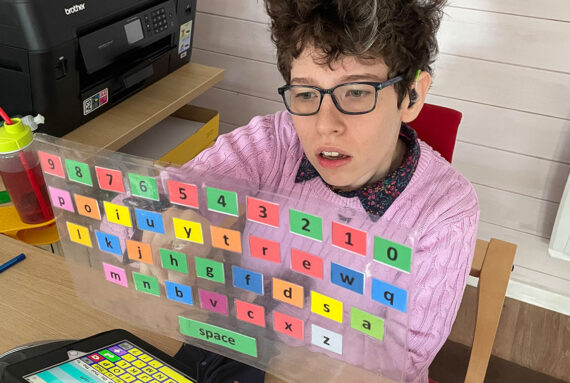 When at 14 school tried to sell me a communication passport it was to give me a low-tech resource in case my electronic communication aid broke down. Whilst they work well for many AAC users I felt I could easily answer basic questions if I was able to spell out an answer. Surprisingly until this point, I’d never had a low-tech AAC resource. Rather than seeing the communication passport as a positive, I felt it took away my independence. The result was I went out and created my own alphabet board for spontaneous conversation. This is a laminated clear sheet (2 sizes exactly the same layout) containing a qwerty layout keyboard, on my side it is the keyboard I have used every day since the age of 4, and on the other side the keyboard is reversed.
My communication partner holds the sheet, and I point with my finger, they can clearly see where I am pointing. The added benefit is because they are sat opposite me I can lip read their responses and watch their facial expressions and body language. With my hearing, this is a win all round for my own ‘listening’ skills and interpretation. And surprisingly I have discovered on a 1-1 basis spelling this way can sometimes be faster than using an electronic device.
Beth’s top tips card
As I said, everyone at my special school carried a communication passport which had basic information about communicating with them. This included their likes and dislikes and family names etc. Whilst I endorse this approach for those people who need it I felt I needed something that was authentically me.
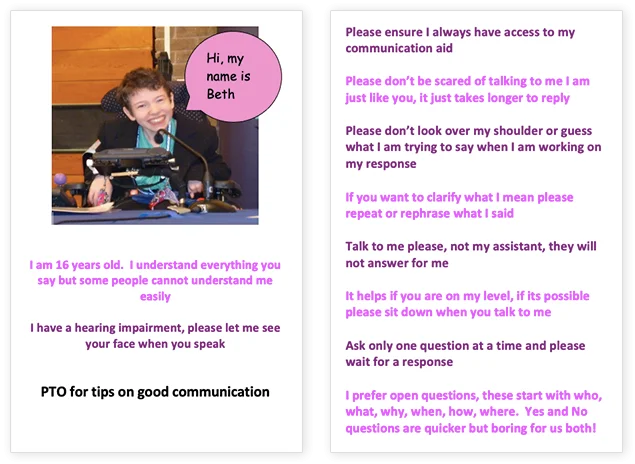
Instead, I created my own communication top tips card which I felt was more appropriate to my needs. The aim was to inform someone who didn’t know me about the basics of communication, what I needed, because I could easily tell them the rest.
This is a copy of my top tips card I created for use in school and being out and about.
Beth’s business card
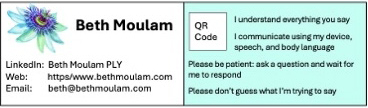
I’ve also carried a business card starting when I was 16. These are ideal for communicating with new people. It is another simple resource that explains my communication by utilising the rear of the card. If you want to add more information then consider adding a QR code to link to a personal communication page.
6 x 60-second scoops: An AAC jargon buster
AAC is full of jargon, I’ve prepared 6 very short videos to explain the different types of AAC, who uses AAC and when, and why communication matters.


